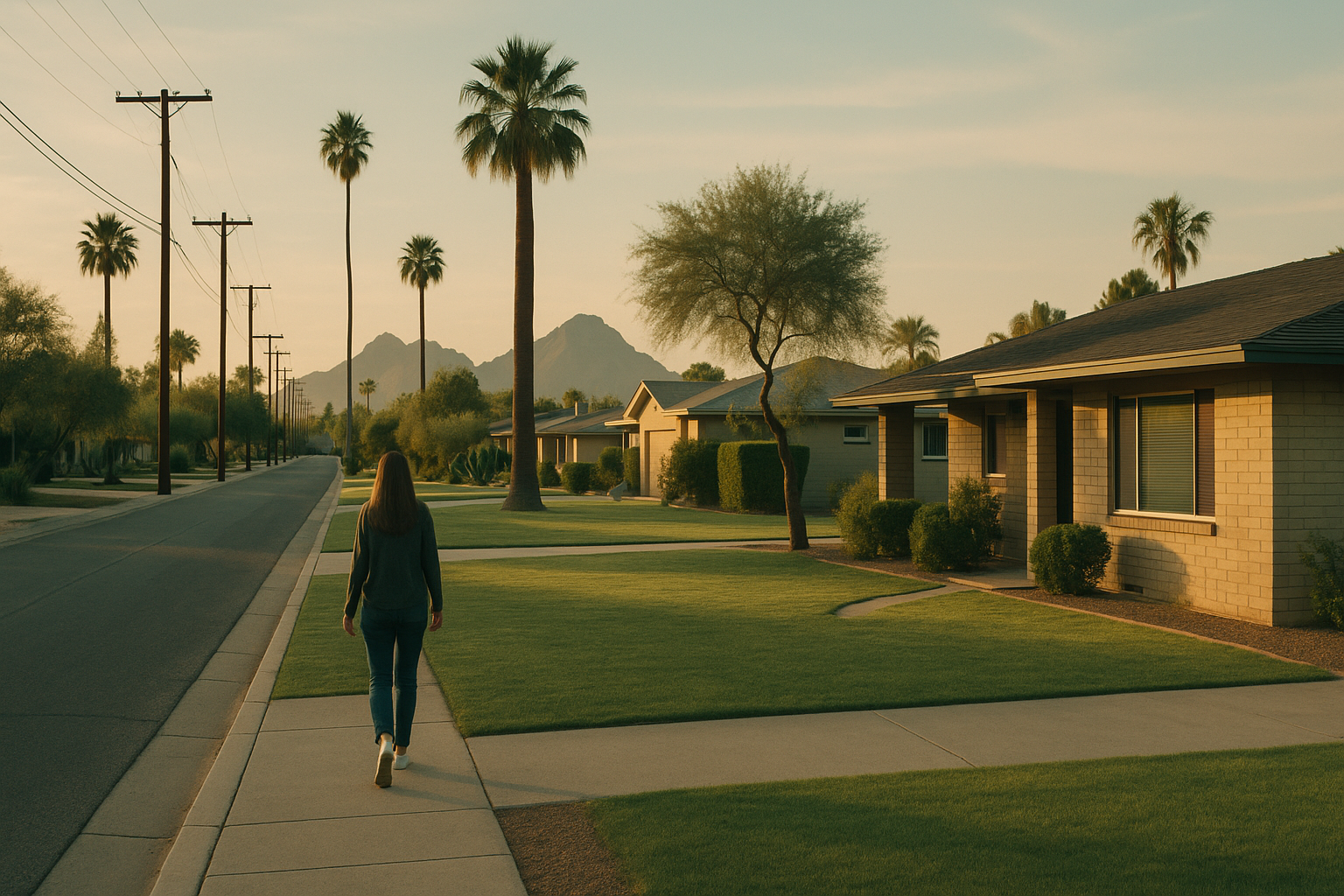
Best Phoenix Neighborhoods for Young Families in 2026
Where to find good schools, yards, and neighbors without the hour-long commute.
If you're house hunting in Phoenix with kids, you're weighing three things that rarely line up: good schools, reasonable commutes, and homes you can actually afford. The metro sprawls across 9,000 square miles, which means the difference between a 20-minute drive and a 50-minute slog is often just three exits on the 101. This guide focuses on neighborhoods where families are actively moving in 2025 and 2026, where elementary schools score above district averages, and where you can find a yard without selling a kidney. We're talking about real streets with sidewalks, not just new construction dropped in the desert with a promise of future parks.
Chandler: East Valley stability with tech job proximity
Chandler sits southeast of Phoenix proper and has become the default choice for families working in tech or healthcare. Intel, Northrop Grumman, and Wells Fargo all have major campuses here, which means your partner's commute might actually be under 15 minutes. The Chandler Unified School District consistently ranks among the top five in the metro, with schools like Basha High and Hamilton High pulling strong test scores and college acceptance rates. Median home prices hover around $550,000 as of late 2025, which is steep but not absurd compared to Scottsdale or North Phoenix.
Neighborhoods like Ocotillo and Fulton Ranch offer community pools, walking trails, and that pseudo-suburban vibe where kids ride bikes in cul-de-sacs. Downtown Chandler has actual bones, a farmers market on weekends, and local coffee shops that aren't chains. The tradeoff is heat and sameness. Summer temps routinely crack 115, and the architecture can feel like every house was built by the same developer in 2008. But if you want predictability, good schools, and jobs nearby, Chandler delivers.
Gilbert: More space, more driving, more families like yours
Gilbert pushes further southeast and trades commute convenience for square footage. If you want four bedrooms, a three-car garage, and a backyard big enough for a playset, Gilbert offers better value per dollar than Chandler. Median home prices sit closer to $520,000, and you'll find newer builds in master-planned communities like Cooley Station, Eastmark, and San Tan Ranch. Gilbert Public Schools perform well, particularly at the elementary level, and the town has invested heavily in parks and rec facilities.
The downside is distance. If you work in central Phoenix or Tempe, you're looking at 35 to 50 minutes each way, and that's assuming the 202 isn't jammed. Gilbert also skews conservative and family-centric to the point where it can feel insular. There's not much nightlife, not much walkability, and entertainment options lean toward trampoline parks and chain restaurants. But if your priority is a safe, kid-focused environment with good schools and elbow room, Gilbert makes sense.
Queen Creek: The frontier with growth pains
Queen Creek sits at the far edge of the metro, bordering actual farmland and open desert. It's the fastest-growing town in Arizona, which means new homes, new schools, and new infrastructure popping up every quarter. Prices start in the low $400,000s for single-family homes, and you can still find lots big enough to feel rural. Queen Creek Unified School District is smaller and newer than Chandler or Gilbert, but test scores are solid and class sizes are manageable.
The problem is isolation. You're 40 minutes from downtown Phoenix on a good day, and there's not much local job market to speak of. Grocery stores, urgent care, and gas stations are all relatively new, and the town still lacks the amenities you'd expect in a mature suburb. If both parents work remotely or one stays home, Queen Creek offers space and value. If you're commuting daily to Tempe or Phoenix, it's a grind. You're also at the mercy of growth. New construction is constant, and traffic patterns shift every six months as roads get widened or rerouted.
Ahwatukee: In-town convenience with Phoenix zip codes
Ahwatukee sits in the far south end of Phoenix, hemmed in by South Mountain and the Gila River Indian Community. It feels like a suburb but technically it's part of Phoenix proper, which means Phoenix services, Phoenix taxes, and access to Phoenix amenities without the 30-mile drive. Homes here range from $450,000 to $700,000 depending on the neighborhood, and you'll find a mix of 1990s builds and newer townhomes. Schools fall under the Kyrene Elementary District (strong) and Tempe Union High School District (mixed, but improving).
Ahwatukee offers hiking access to South Mountain, solid local parks, and a 20-minute shot up I-10 to Tempe or downtown Phoenix. The neighborhood has mature trees, established HOAs, and a sense of place that newer subdivisions lack. The tradeoff is age. Many homes need updates, and you're not getting the open floor plans or smart-home wiring that come standard in Gilbert or Queen Creek. If you value location over newness and want to stay inside the Loop 101, Ahwatukee is worth the look.
What to prioritize when choosing
Start with commute. Plug your work address into Google Maps and test drive times at 7:30 a.m. on a weekday. Phoenix traffic is not LA, but the 101, 202, and I-10 all bottleneck during rush hour, and adding 20 minutes each way compounds fast over a year. Next, tour schools in person. GreatSchools ratings are a starting point, but they don't capture teacher turnover, class size, or campus culture. Walk the hallways, check the parking lot, and ask neighbors with kids.
Finally, think about resale. Neighborhoods that attract families today will likely attract families in five years, but check permit data to see what's being built nearby. If a new high school or grocery-anchored shopping center is coming, that's a tailwind. If the next phase of development is industrial or high-density apartments, factor that into your offer. Phoenix is still growing fast, and the winners in 2026 are neighborhoods that balance schools, jobs, and infrastructure without feeling like construction sites.
Frequently asked
What's the best school district in the Phoenix area for families?
Chandler Unified and Kyrene Elementary consistently rank at the top for academic performance, with high graduation rates and strong teacher retention. Scottsdale Unified also scores well but comes with higher home prices. Visit individual school websites and check state report cards for current data, since district-level averages can hide wide variation between schools.
How much house can I afford in Phoenix suburbs on a $150,000 household income?
With standard lending ratios and a 10% down payment, you're looking at homes in the $450,000 to $550,000 range, assuming manageable debt and decent credit. That puts you squarely in Gilbert, parts of Chandler, and Queen Creek. Scottsdale and North Phoenix push higher. Get pre-approved before you tour so you're shopping with real numbers, not Zillow estimates.
Is it worth buying new construction in Gilbert or Queen Creek?
New construction eliminates maintenance headaches for the first few years and often includes energy-efficient features that cut utility bills. The downside is lack of mature landscaping, neighborhood amenities that take years to materialize, and builder-grade finishes that feel cheap. If you plan to stay five-plus years and want turnkey living, it's a solid move. If you're flipping in three, you're competing with identical homes on the same street.
What's the commute like from Gilbert to downtown Phoenix?
Expect 35 to 50 minutes depending on your starting point and route. The 202 and Loop 101 are your main arteries, and both can clog between 7 and 9 a.m. If you're doing this daily, test the drive during your actual work hours before you commit. Remote work or flexible schedules make Gilbert far more livable for families with Phoenix-based jobs.
Are Phoenix home prices still rising in 2026?
Phoenix saw rapid appreciation from 2020 to 2022, a correction in 2023, and modest gains in 2024 and 2025. As of early 2026, prices are up slightly year-over-year but nowhere near the double-digit jumps of the pandemic era. Inventory has improved, which means less competition and more negotiating room for buyers. That said, good school districts still move fast.