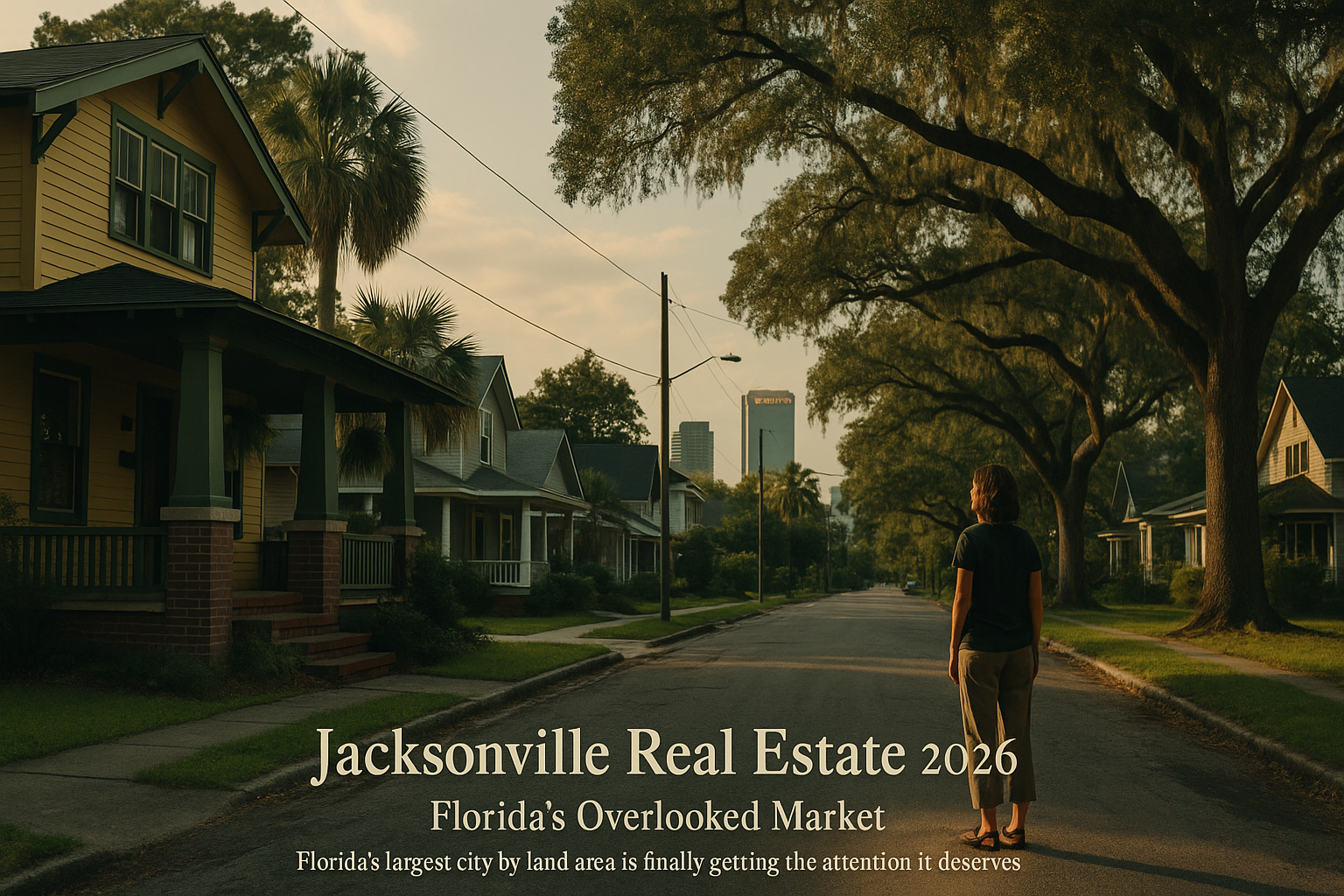
Jacksonville Real Estate 2026: Florida's Overlooked Market
Florida's largest city by land area is finally getting the attention it deserves.
Jacksonville sits on 875 square miles of land, more than any other city in the continental US, yet most people shopping Florida real estate skip straight to Miami, Tampa, or Orlando. That's changing fast. The city added around 18,000 net new residents in 2023 (per Census estimates), corporate relocations keep landing (think Fidelity, Black Knight, Deutsche Bank operations), and median home prices still hover around $360,000, roughly 30% below Tampa and 50% below Miami. The 2026 outlook is simple: Jacksonville offers genuine Florida waterfront access, no state income tax, a deepwater port economy, and room to sprawl without the sticker shock. If you've been priced out of the Sunbelt's headline markets, this is the one you should actually research.
Why Jacksonville Flies Under the Radar
Jacksonville doesn't have South Beach nightlife or Disney proximity, so it never became a brand name. It's a working port city with Navy infrastructure, insurance company headquarters, and logistics hubs. That unsexy foundation is exactly why it works for people who need affordability and job stability over Instagram backdrops. The metro spans Duval, Clay, St. Johns, and Nassau counties, giving buyers everything from urban riverfront condos to rural acreage in under 45 minutes.
The market also benefits from geographic sprawl. Because the city limits are so large, new construction doesn't push prices into nosebleed territory the way it does in Tampa or Austin. Developers have land to work with. That keeps supply flowing and gives first-time buyers actual options under $300,000 in decent school zones, something nearly extinct in Florida's other major metros.
The Neighborhoods People Are Actually Buying In
Riverside and Avondale pull the creative class and young professionals who want walkability, historic homes, and river views. These neighborhoods sit just southwest of downtown along the St. Johns River. Expect bungalows and craftsman-style houses in the $400,000 to $650,000 range, older stock but with character. Five Points is the commercial heart, dense with coffee shops and bars. If you want Brooklyn vibes in Florida, this is your zone.
Nocatee in Ponte Vedra (technically St. Johns County) is the opposite: master-planned, family-focused, new everything. It's one of the fastest-selling communities in the Southeast, with homes ranging from the high $300,000s to over $1 million. You get resort-style amenities, A-rated schools, and a 20-minute drive to Jacksonville Beach. It's suburban but polished, and inventory moves quickly. San Marco, just south of downtown, splits the difference: walkable, waterfront, historic, but pricier than Riverside. Think $500,000 and up for anything livable.
What's Driving Growth in 2026
Corporate relocation is the biggest tailwind. Companies love Jacksonville's tax structure, port access, and cost advantage over South Florida. Fidelity employs thousands here. Deutsche Bank runs a major tech campus. The logistics and finance sectors keep adding mid-level and senior roles, which means educated workers with real buying power. Those transplants come from the Northeast and Midwest, often trading a $450,000 condo in a cold climate for a $380,000 house with a yard and no snow.
The second factor is infrastructure investment. JAXPORT is undergoing a multi-year deepening project to accommodate post-Panamax cargo ships, which will expand trade volume and related job creation. The city is also pushing mixed-use development downtown, trying to shift the perception from sleepy government town to actual urban center. It's early, but projects like the Jaguars stadium district and riverfront redevelopment are real money, not renderings. If those efforts stick, downtown property values could see a legitimate re-rating over the next five years.
The Honest Downsides
Jacksonville sprawls in a way that makes car dependency unavoidable. Public transit is minimal. If you're used to subway access or dense walkable neighborhoods, you'll find most of Jacksonville frustrating outside Riverside and San Marco. Traffic isn't terrible by Sun Belt standards, but you're still driving 30 minutes for most errands unless you live in a very specific pocket.
The city also has income inequality and school quality variance that doesn't get talked about enough. Duval County Public Schools have some excellent magnet programs and A-rated elementaries, but the district as a whole is uneven. Families serious about public school quality gravitate toward St. Johns County (Nocatee, Fruit Cove) or specific Duval zones like Ortega or Mandarin. Do your homework on assigned schools before you buy. The other tradeoff: summers are oppressively humid. If you hate heat, this isn't your market.
Rent vs. Buy Math in 2026
Renting a two-bedroom apartment in a decent Jacksonville neighborhood costs around $1,600 to $2,000 per month. A comparable single-family home with a 7% mortgage (assuming 10% down on a $360,000 purchase) runs roughly $2,600 per month including property tax and insurance. That gap is narrower than it was three years ago, but buying still makes sense if you plan to stay five-plus years and can handle the upfront costs.
The bigger advantage to buying is equity capture in a growing market. If Jacksonville home values appreciate even 3% annually (conservative relative to recent trends), you're building around $11,000 in equity per year just from price growth, plus whatever you pay down on principal. Renters get flexibility but zero equity. In a city where corporate transplants keep arriving and inventory stays tight, ownership tilts favorably for people with stable income and a medium-term horizon.
How to Play This Market Smart
If you're buying in 2026, focus on neighborhoods with infrastructure momentum or established demand. Riverside, San Marco, Nocatee, and Mandarin have staying power. Avoid speculating on fringe areas unless you're genuinely okay with a longer hold and less liquidity. Jacksonville isn't a flip market; it's a live-there-and-build-equity market.
For investors, single-family rentals in B and C-plus neighborhoods can pencil at around 6% to 8% cap rates if you buy right, particularly near Naval Air Station Jacksonville or the Southside corporate corridor. Short-term rentals work near the beaches (Jacksonville Beach, Atlantic Beach) but require active management and dealing with seasonal variability. The safest play is long-term rentals targeting stable renters in job-dense areas. Get local property management if you're out of state. This isn't a market you can autopilot from 1,000 miles away.
Frequently asked
Is Jacksonville a good place to buy a house in 2026?
Yes, if you want Florida living without Miami or Tampa prices. Jacksonville offers solid job growth (finance, logistics, healthcare), relatively affordable homes (median around $360,000), and no state income tax. It's not flashy, but it's stable and growing. Best for families, remote workers, and corporate transplants who prioritize cost and space over nightlife and walkability.
What salary do you need to buy a home in Jacksonville?
For a median-priced home around $360,000, you'd want household income of at least $90,000 to comfortably afford the mortgage, taxes, and insurance (using the rough 28% front-end debt ratio). If you're looking at Nocatee or San Marco where prices run $450,000-plus, aim for $115,000 or higher. Lower-priced neighborhoods in the $250,000 range are doable on $65,000 to $75,000 household income.
Which Jacksonville neighborhoods have the best schools?
St. Johns County neighborhoods like Nocatee, Fruit Cove, and Julington Creek consistently have A-rated schools. Within Duval County, look at Mandarin (Loretto Elementary, Mandarin Middle), Ortega (Ortega Elementary), and San Jose (San Jose Elementary). Use GreatSchools or the district's own ratings, but also visit schools and talk to parents. School quality varies block by block in some Duval zones.
Is Jacksonville cheaper than Tampa or Orlando?
Yes, by a meaningful margin. Jacksonville's median home price sits around 25% to 30% below Tampa and roughly 15% below Orlando as of early 2026. Rent is also cheaper. The tradeoff is less entertainment density and fewer direct flights, but if affordability is the priority, Jacksonville wins. You're getting similar Florida tax benefits and weather for significantly less money.
Does Jacksonville have a good real estate investment opportunity?
It's solid but not spectacular. Long-term single-family rentals near employment hubs (Southside, Orange Park, Mandarin) can hit 6% to 8% cap rates with stable tenants. Appreciation is moderate, typically 3% to 5% annually in decent neighborhoods. It's not Austin or Phoenix in the boom years, but it's also not speculative. Good for buy-and-hold investors who want cash flow and low drama.