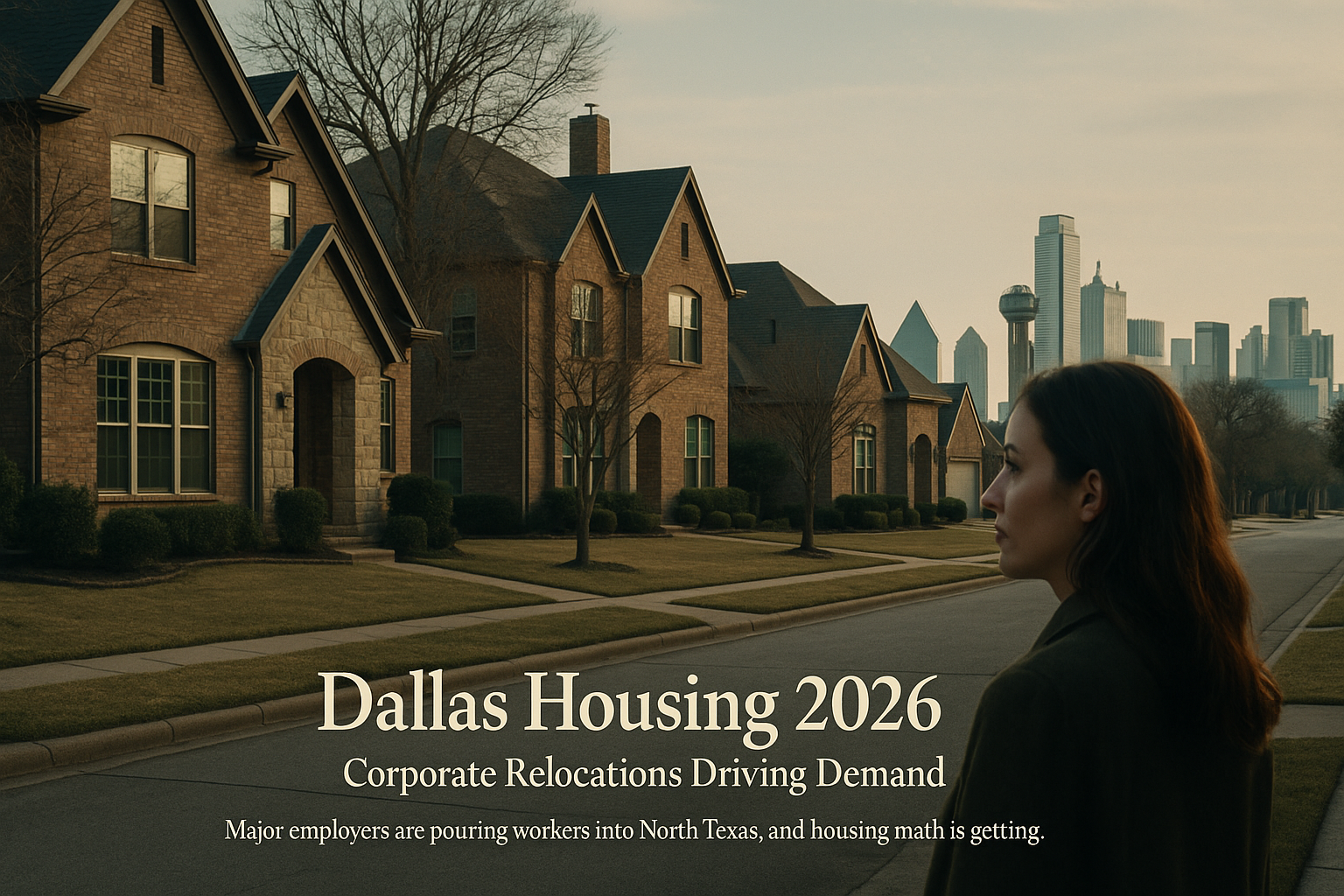
Dallas Housing 2026: Corporate Relocations Driving Demand
Major employers are pouring workers into North Texas, and the housing math is getting interesting.
Dallas added around 120,000 net new residents in 2023 and 2024 combined, and corporate relocations are a big piece of that. Companies like Goldman Sachs, State Farm, and Liberty Mutual already built major hubs here. Now smaller tech firms, finance operations, and healthcare groups are following the same math: lower cost, no state income tax, and a labor pool that doesn't require a $200k salary to live decently. That migration wave is colliding with a housing market that's building fast but still can't keep up in the most desirable pockets. If you're buying, selling, or trying to figure out what your house is worth in 2026, the corporate relocation story matters more than interest rates right now.
Where the new workers are actually landing
Corporate relocations don't distribute evenly. The biggest concentrations are landing in three zones: the Legacy West corridor in Plano, the Las Colinas area near the new State Farm campus, and downtown Dallas itself, where Goldman's new tower pulled a bunch of finance talent. Those three areas are seeing the tightest inventory and the fastest appreciation. Plano's median home price climbed around 8% year-over-year through late 2025, per local MLS data, while the broader Dallas metro ran closer to 5%.
But there's a secondary pattern worth watching. Mid-level employees, especially those with families, are skipping the expensive inner ring and going straight to Frisco, McKinney, and parts of Prosper. These suburbs offer newer builds, good schools, and reasonable commutes to the corporate campuses. Frisco alone issued over 3,000 residential building permits in 2024, and builders are still scrambling to keep up. If you're a buyer competing in these markets, expect multiple offers on anything priced right and move-in ready.
Inventory is tight where it matters, loose where it doesn't
Dallas has inventory, but it's not distributed the way demand is. The inner suburbs near job centers, anything inside the outer loop with a decent school rating, is sitting at around 2 months of supply as of early 2026. That's a seller's market by any measure. Meanwhile, exurbs like Kaufman or parts of southern Dallas County have closer to 5 or 6 months of inventory, which gives buyers actual negotiating room.
The mismatch creates weird pricing dynamics. A 2,200-square-foot house in McKinney might list for $525k and get five offers in a week. The same square footage in Terrell, 40 minutes east, lists for $340k and sits for 45 days. Corporate relocators with kids and two-income households are paying the premium to stay close to the office and the better school districts. If you're a seller in one of those hot pockets, you have leverage. If you're selling farther out, you need to price aggressively from day one.
Rent or buy? The math shifted in 2025
For the first couple years of the relocation wave, most newcomers rented while they figured out the market. But rent inflation in Dallas caught up. A two-bedroom apartment in Uptown or Plano now runs $2,200 to $2,800 a month for anything decent, per Zillow estimates. At that price, the rent-versus-buy calculation tips in favor of buying if you're planning to stay more than three years and can scrape together a down payment.
Mortgage rates are still elevated compared to 2020 and 2021, sitting around 6.5% to 7% for conventional 30-year loans in early 2026. But appreciation in the target neighborhoods is running fast enough that waiting another year often costs you more in price escalation than you'd save in potential rate drops. If you're relocating for work and your company is offering relocation assistance, use it. A lot of buyers are negotiating rate buydowns or seller credits to offset the financing cost, and in a hot pocket, sellers are sometimes willing to play ball just to close fast.
Which neighborhoods are absorbing the most corporate buyers
Plano's west side, especially anything near the Legacy West development, is ground zero for finance and tech relocators. The area has walkable retail, new apartment towers, and single-family neighborhoods that feed into highly rated Plano ISD schools. Prices start around $450k for older stock and run past $1 million for new builds with any size. It's expensive by Dallas standards, but it's still half the cost of equivalent neighborhoods in the Bay Area or Seattle, which is the comparison corporate buyers are making.
Frisco and McKinney attract families who want newer construction and a bit more space. Frisco ISD and McKinney ISD both rank well statewide, and the housing stock skews toward 2010s builds with open floor plans and two-car garages. Median prices in Frisco are around $575k, per MLS data, while McKinney runs closer to $480k. Las Colinas, near the State Farm and Liberty Mutual campuses, is pulling a different demographic: single professionals and younger couples who want shorter commutes and don't need a big yard. Condos and townhomes in Las Colinas start around $280k and offer a faster path to ownership than competing in the single-family market.
What sellers need to know if they're competing with new builds
If you own a house built before 2010 in one of these hot markets, you're competing with new construction. Builders in Frisco and Prosper are offering incentives: rate buydowns, upgraded appliances, paid closing costs. That makes resale tougher unless you price below the builder's base price or your house has something new builds don't, like a bigger lot, mature trees, or a location closer to an established part of town.
The move is to stage well, handle deferred maintenance before listing, and price within 5% of recent comps. Don't try to stretch and hope. Corporate buyers are comparison shopping hard, and they'll walk if your house feels overpriced relative to a new build down the street. If your house is in a neighborhood builders haven't reached yet, like parts of older Plano near 15th Street or Richardson near the DART line, you have an advantage: scarcity. Play it up.
What happens if the relocation wave slows
No migration trend lasts forever. If the national economy softens or companies pull back on expansion, the relocation wave could taper off by late 2026 or 2027. That would take some heat out of the market, especially in the suburbs that are currently seeing bidding wars. Inventory would rise, days on market would stretch, and buyers would regain negotiating leverage.
But even in that scenario, Dallas has structural advantages. The metro is still growing from internal population dynamics, the job base is diversified beyond just corporate relocations, and the cost-of-living gap versus coastal cities isn't going away. A slowdown would feel like a return to normal, not a crash. If you're buying in 2026 and worried about timing the top, focus on neighborhoods with strong fundamentals: good schools, job center proximity, and housing stock that appeals to a broad buyer pool. Those areas hold value even when the market cools.
Frequently asked
Are corporate relocations still happening in Dallas in 2026?
Yes. While the initial wave from 2020 to 2023 was the most dramatic, companies are still expanding operations in Dallas. Smaller firms, satellite offices, and healthcare groups are following the path set by larger employers. The pace is steadier now, but the trend hasn't reversed. Neighborhoods near major corporate campuses like Legacy West, Las Colinas, and parts of Frisco are still seeing strong buyer demand from relocating workers.
Which Dallas neighborhoods are best for corporate relocators with families?
Frisco, McKinney, and west Plano are the top three for families. All three offer highly rated public schools, newer housing stock, and reasonable commutes to the major job centers. Frisco ISD and Plano ISD consistently rank among the best in the state. Home prices range from around $450k to $600k depending on the neighborhood and home age. If you want walkability and proximity to retail, Plano near Legacy West is the move. If you prioritize space and newer builds, Frisco and McKinney offer better value per square foot.
Is it better to rent or buy in Dallas if I'm relocating for work?
If you're planning to stay more than three years and can afford a down payment, buying usually makes more financial sense in 2026. Rents in desirable areas like Uptown, Plano, and Frisco are running $2,200 to $2,800 a month for decent two-bedroom units. At that rate, a mortgage payment on a $450k to $500k house is comparable, and you're building equity instead of paying a landlord. Mortgage rates are elevated, but home appreciation in the target neighborhoods is outpacing the financing cost. If you're uncertain about your stay duration or still learning the market, rent for a year and then buy once you know where you want to be.
How competitive is the Dallas housing market in 2026?
It depends on location. Neighborhoods near corporate job centers, anything in Plano, Frisco, or McKinney with good schools, are highly competitive. Homes priced correctly get multiple offers within days, and inventory sits around 2 months of supply. Farther-out suburbs and exurbs like Terrell or parts of southern Dallas County have much more inventory and longer days on market, giving buyers negotiating room. If you're buying in a hot pocket, expect to move fast, waive some contingencies, and possibly offer over asking on well-priced homes.
What should I know about selling a house in Dallas in 2026?
If your house is in a high-demand area near job centers and good schools, you have strong leverage. Price it within 5% of recent comps, handle obvious maintenance issues, and stage it well. You'll likely get multiple offers. If you're in a neighborhood where builders are active, you're competing with new construction, so price aggressively and highlight what makes your house unique, like a bigger lot or mature landscaping. If you're selling in a slower market farther from the core, expect longer days on market and be ready to negotiate. Overpricing costs you time and leverage, so start realistic.