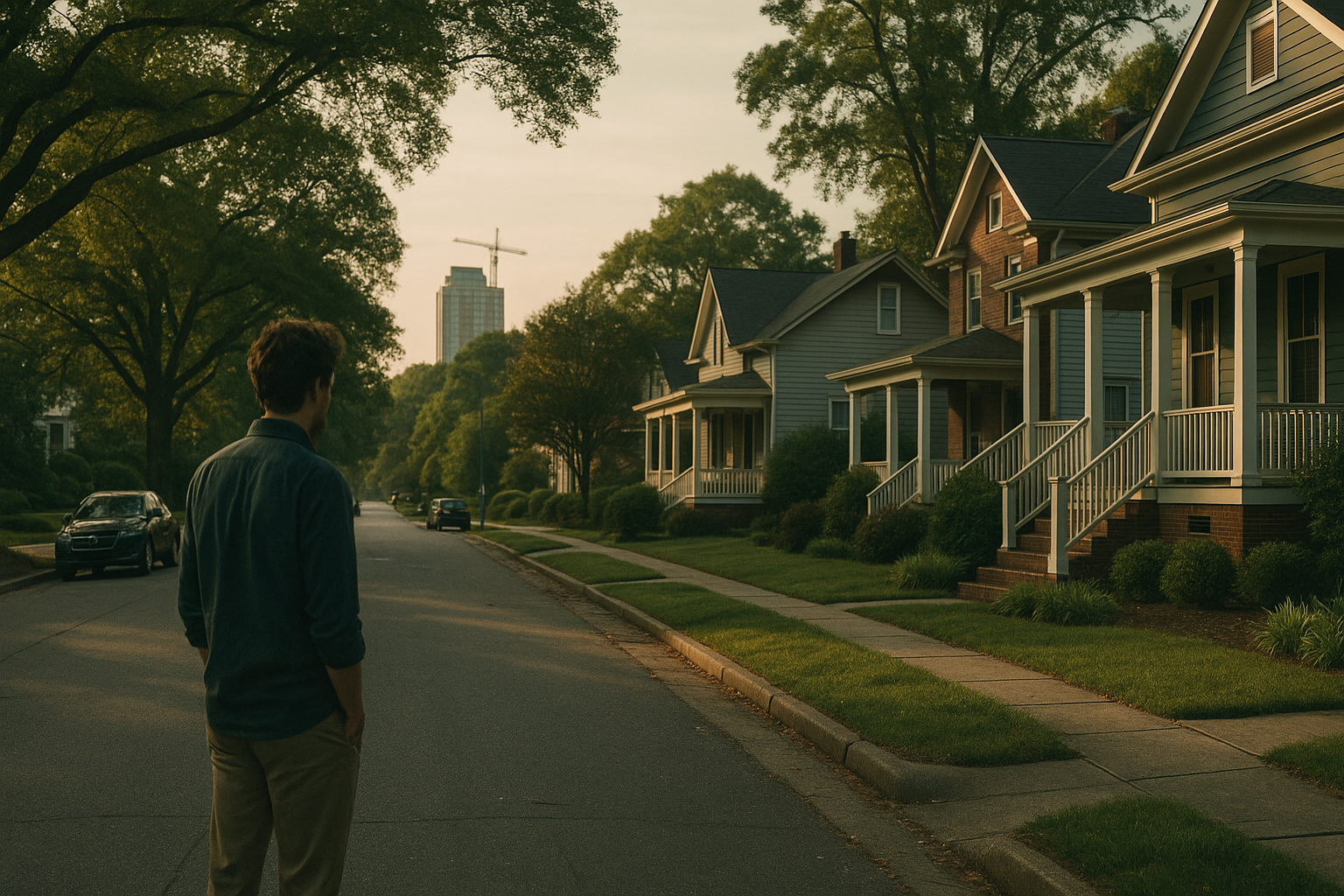
Raleigh-Durham Housing 2026: What Research Triangle Buyers Need to Know
Apple's campus, pharma expansion, and remote-worker migration are colliding with the Triangle's housing supply in ways most national headlines miss.
Raleigh-Durham housing in 2026 isn't the sleepy value play it was five years ago, but it's also not the overheated chaos you'll find in Austin or Nashville. The Research Triangle sits in a weird middle ground: corporate expansion is real (Apple's mixed-reality campus in RTP, Novo Nordisk's billion-dollar Morrisville build-out, continued biotech clustering), migration from the northeast and midwest continues at a steady clip, and yet inventory has loosened compared to the 2021-2022 frenzy. That means actual choice for buyers, but also real competition for well-located homes near good schools or walkable pockets. This article breaks down what the Triangle's housing market actually looks like right now, where the pressure points are, what neighborhoods are absorbing growth, and what buyers should watch as 2026 unfolds.
Price Reality: The Triangle Is No Longer Cheap, But It's Not Bay Area Either
Median home prices across Raleigh-Durham proper sit around $425,000 as of early 2026, per regional MLS data. That's up roughly 60% from 2019 but relatively flat compared to late 2022. The spike happened. Now we're in a plateau with selective pockets seeing continued appreciation. Inside the Beltline in Raleigh (think Five Points, Oakwood, Mordecai) and close-in Durham neighborhoods like Old West Durham or Watts-Hillandale, you're looking at $550,000 to $850,000 for renovated single-families. Suburban Cary, Apex, and Morrisville—where most corporate relocators land—range from $475,000 to $650,000 depending on school zone and lot size.
The thing many buyers miss: property taxes in Wake County run around 0.84%, and Durham County is closer to 1.03%. That's lower than Texas or New Jersey, but it's not trivial when you're financing $500,000. Also, HOA fees in newer master-planned communities (Wendell Falls, Briar Chapel) can hit $150 to $300 monthly. Budget the whole nut, not just the mortgage.
Inventory and Speed: You Have Time to Think, But Not Forever
The Triangle's months-of-supply hovers around 2.8 to 3.2 depending on the submarket, which is up from the sub-one-month chaos of 2021 but still technically a seller's market (balanced is closer to five or six months). In practice, this means: you won't get into 15-offer bidding wars on every decent listing, but a well-priced home in a top school zone will still move in under two weeks with multiple offers. Fixer-uppers and anything with deferred maintenance or a weird floorplan sit longer, sometimes 40 to 60 days.
New construction is still flowing, especially in the outer suburbs (Rolesville, Holly Springs, Fuquay-Varina, Knightdale). Builders are offering incentives again—rate buy-downs, closing cost credits, sometimes upgrades—because they're sitting on spec inventory. If you're open to a 30-minute commute and a subdivision with a median strip of pine trees, you have leverage. If you want walkability or an established street grid, expect competition and bring your pre-approval locked.
Where Corporate Growth Is Actually Landing
Apple's mixed-reality engineering campus is anchored in Research Triangle Park, but most of those employees aren't living in RTP itself (there's almost no housing stock there). The big absorption zones are Morrisville, Cary, and the southeast Raleigh corridor along I-40. Morrisville in particular has added thousands of apartment units and townhome developments in the past three years, targeting the young engineer and dual-income household demographic. Rents for a two-bedroom in a new Morrisville complex run $2,100 to $2,500, which pencils close enough to owning that many are buying townhomes in the $380,000 to $450,000 range instead.
Novo Nordisk's insulin manufacturing expansion, also in Morrisville, is pulling a similar cohort but slightly older (mid-30s, families). The result is that Morrisville's school capacity is under pressure, and home price appreciation there has outpaced Raleigh proper over the past 18 months. On the Durham side, biotech and health-tech growth around Duke and the American Tobacco Campus is feeding demand in Old North Durham, Lakewood, and parts of South Durham near Southpoint. Those buyers tend to value walkability and historic character more than subdivisions, so that stock turns faster and at higher price-per-square-foot.
Neighborhood Breakdown: Where to Look and What the Tradeoffs Are
Inside-the-Beltline Raleigh offers walkability, older tree canopy, and proximity to downtown, but you're paying $140 to $160 per square foot and often dealing with homes built in the 1940s to 1970s that need electrical or HVAC work. Five Points and Cameron Village are the most expensive pockets. Mordecai and Oakwood offer slightly better value if you're okay with a renovation project. North Raleigh (Falls of Neuse corridor, North Hills area) is where you get newer builds, bigger lots, and top-rated public schools (Leesville Road High, Wake Forest High). Prices run $500,000 to $700,000 for move-in-ready single-families.
Cary and Apex are the default suburbs: excellent schools, low crime, good parks, but very car-dependent and aesthetically generic. If you have kids and value school ratings above all else, this is the path. Durham's close-in neighborhoods (Ninth Street area, Trinity Park, Duke Park) are more eclectic and slightly cheaper than comparable Raleigh addresses, but Durham's public schools are hit-or-miss outside a few magnets, so many families opt for private or charter. Chapel Hill and Carrboro offer the best walkability in the Triangle but the tightest inventory and highest prices per square foot—think $525,000 for a 1,400-square-foot bungalow.
What to Watch Through the Rest of 2026
Interest rates matter more here than in some markets because the Triangle's buyer pool is heavily employed in sectors that got hammered by rate hikes (tech layoffs, reduced VC funding, biotech funding slowdowns). If the Fed cuts further and rates drop below 6% for a 30-year fixed, expect demand to spike again, especially in the $350,000 to $500,000 band where first-time buyers and young families cluster. Inventory could tighten fast. If rates stay elevated or tick back up, the current plateau holds and you'll see more price cuts on overpriced listings.
Also watch transit development. The Wake County transit plan includes commuter rail from Garner through downtown Raleigh to Durham and eventually Chapel Hill, though construction timelines keep sliding. If funding gets locked in and shovels actually hit dirt, anything within a half-mile of a proposed station will appreciate faster than the broader market. Right now those corridors (New Bern Avenue, Capital Boulevard, South Saunders) are still relatively affordable, but they won't stay that way if rail becomes real.
Frequently asked
Is Raleigh-Durham still a good place to buy in 2026?
Yes, if your job is stable and you plan to stay at least five years. The Triangle's economy is diversified enough (tech, pharma, education, government) that it doesn't crater during national downturns the way single-industry metros do. Prices have cooled from the 2021-2022 peak, so you're not buying at the absolute top. The risk is that if remote work reverses hard and corporate growth stalls, appreciation could stay flat for a few years. But long-term fundamentals (population growth, job growth, quality of life) are solid.
What's the difference between buying in Raleigh versus Durham?
Raleigh skews newer, more corporate, more suburban. Durham skews older housing stock, more eclectic culture, more neighborhood-to-neighborhood variation. Raleigh's public schools are generally stronger across the board. Durham has pockets of great schools but also some struggling ones, so you have to be more selective. Durham is slightly cheaper per square foot in comparable neighborhoods, but you also have to account for potentially higher renovation costs on older homes. Both cities have good food scenes and decent walkability in their core neighborhoods, but Raleigh's downtown is still catching up to Durham's.
Should I wait for prices to drop more, or buy now?
Prices aren't likely to drop significantly unless there's a major recession or RTP sees mass layoffs, neither of which seems imminent as of early 2026. What you might see is more individual sellers getting realistic and cutting asking prices on overpriced listings, which creates selective buying opportunities. If you're ready financially and you find a place that works, waiting to time the market perfectly usually costs you more in rent and opportunity cost than you save. If rates drop and demand surges again, you'll be competing with a bigger buyer pool.
How much do I need for a down payment in the Triangle?
Conventional wisdom is 20% to avoid PMI, which means $85,000 to $100,000 for a median-priced home. But plenty of buyers are using 10% or even 5% down, especially first-timers using FHA or conventional loans with PMI. Monthly costs go up, but if you're currently paying $2,200 in rent, a mortgage with PMI might only be $2,500 to $2,700 depending on rates. The real question is whether you have enough cash reserve after the down payment for closing costs, moving, and an emergency fund. Don't drain your entire savings to hit 20%.